I ran the Chicago Marathon on October 8, 2023. These are my notes on race preparation and execution (as usual, mostly written to remind myself about the experience in decades to come).
Result
2:48:42 (6:26/mi, 4:00/km), 1,184 / 48,292 overall, 1,093 / 25,672 males, 200 / ??? AG males 35 to 39
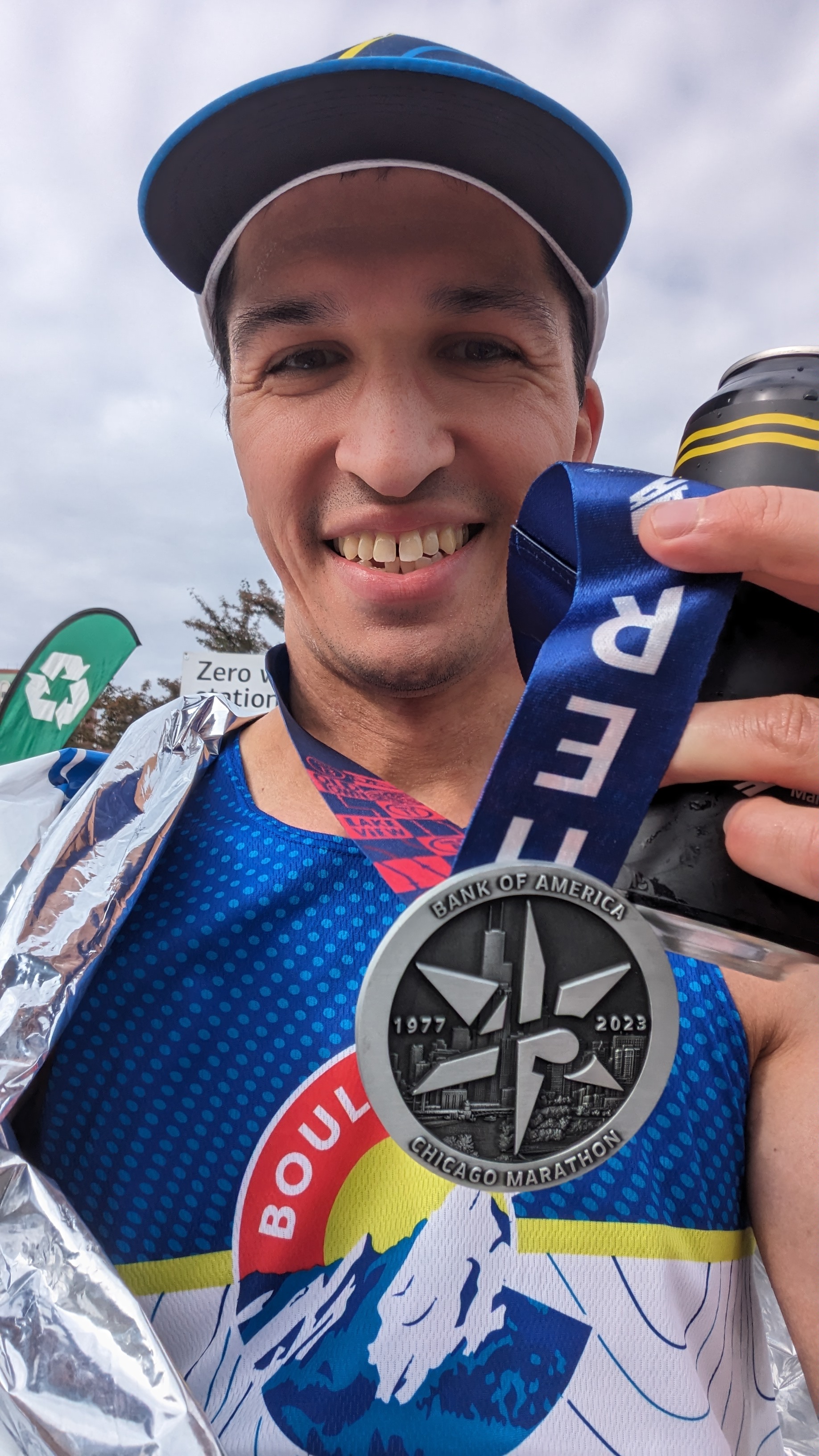
Goals
✓ Goal A: Sub-2:55
✓ Goal B: Sub-2:58:41 (to set a new PR)
Training
Right after the NYC Marathon in 2022, probably while lying in bed with COVID, I learned that the guaranteed entry qualifying time for the Chicago Marathon is 3:10 for my age group. With my 2:59:59 race from the spring as well as my disappointing results in NYC in mind, plus not knowing what my Boston race result would be, I panic-applied to the Chicago Marathon.
Boston went really well (and I’m still amazed and delighted by my experience), but I knew from the low severity of soreness in walking back to my hotel room that I left some time out there on the course. Recovery was pretty easy; I took a few days off, but then picked it up to at least get some mileage in before the BolderBoulder 10k in a little over a month from then. That said, by the time BolderBoulder rolled around, I still felt a little fatigue in my legs; I probably should have taken some more time off. That race didn’t go as planned and I jogged it in for a 42 minute result.
I took three weeks to just have fun with running and to take more days off than usual. I had fun running on a family vacation in Aspen at 8,000 ft (2,438m). Then training really began.
Since I enjoyed and had a good result from the McMillan Boston-specific program, I decided to use his Chicago-specific program for this cycle. From mid-June through October, I stuck pretty closely to the prescribed plan. I hit my paces for workouts and got to the desired mileage. I tried to keep up with some faster runners in my club during long runs, which was mostly successful. The main interruption was a week of travel; to Maine, where I enjoyed my 16 mile (26 km) run down back roads in Augusta, Maine, with very courteous drivers, and to New Jersey, which I continue to dislike.
I ran a local half marathon as a tune-up race and PR’ed by 20 seconds at 1:27 high, but the notable difference was that this race was at altitude. The VDOT calculator converts this to a 1:24 sea-level half and a 2:56:30 sea-level marathon, so this gave me a confidence boost that my goals were within reach. The next week, I set an unofficial PR in the company 5k during an absolute downpour, which has now made me want to see what I can do in good weather.
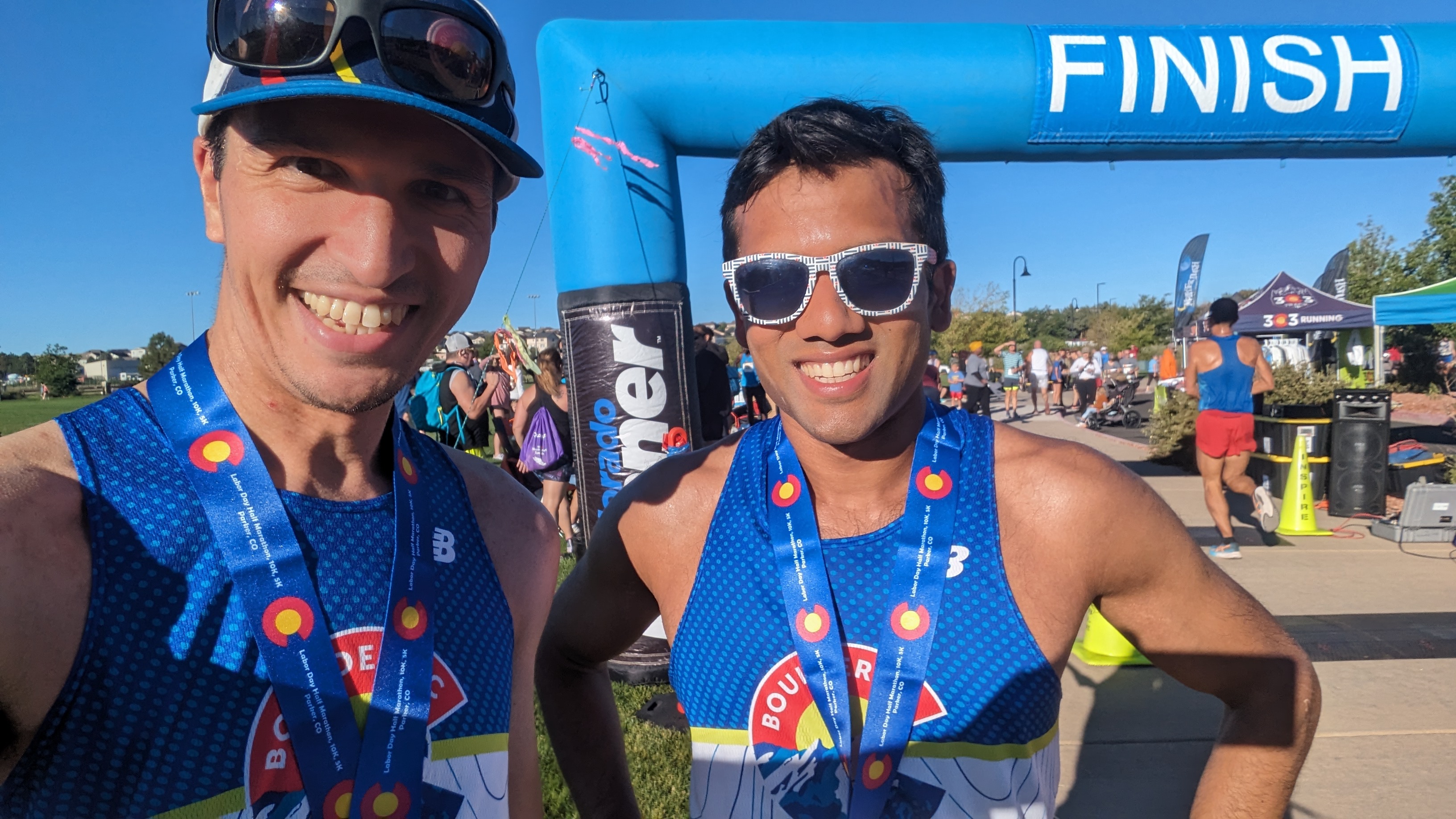
My last big long run was fast and smooth. I went into the taper weeks feeling good. I had a niggle of knee pain, but heat therapy worked wonders and it felt better when I was running.
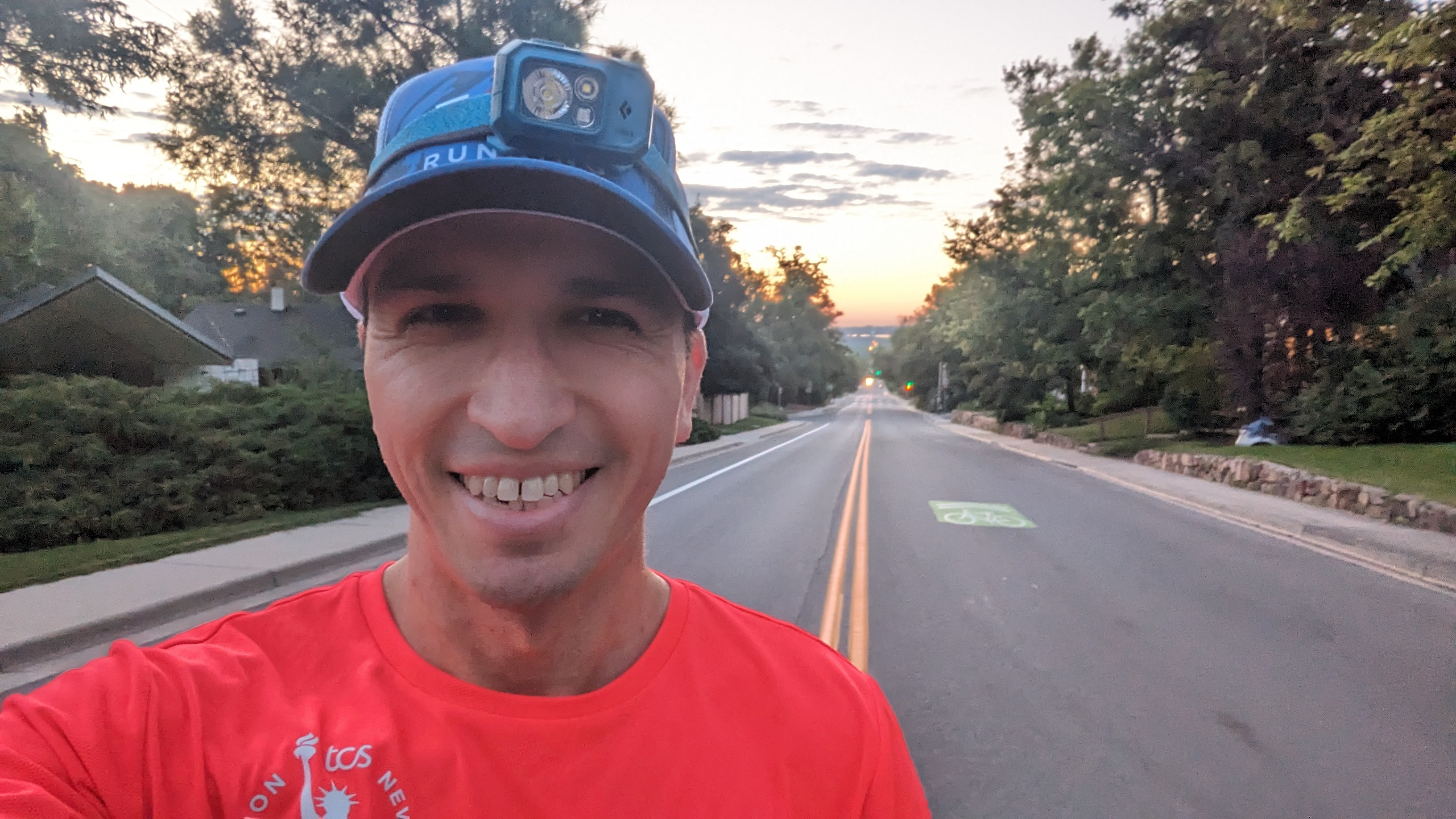
Life did intervene and required early runs, sometimes.
By the end of the taper, I distinctly missed the 20+ mile runs of earlier weeks.
Race Weekend
I flew into Chicago late Friday evening for the race on Sunday. The last time I was in New York City, Yuko and I went to a sushi restaurant created by the two-Michelin-starred, Chicago-based Moody Tongue and had a great time with an excellent omakase and even better beer pairings. I knew I’d want to bring some of their beer home, so I brought inflatable bottle protectors and an empty suitcase. I have now determined that my suitcase can fit, with protection, exactly 14 bottles of beer.
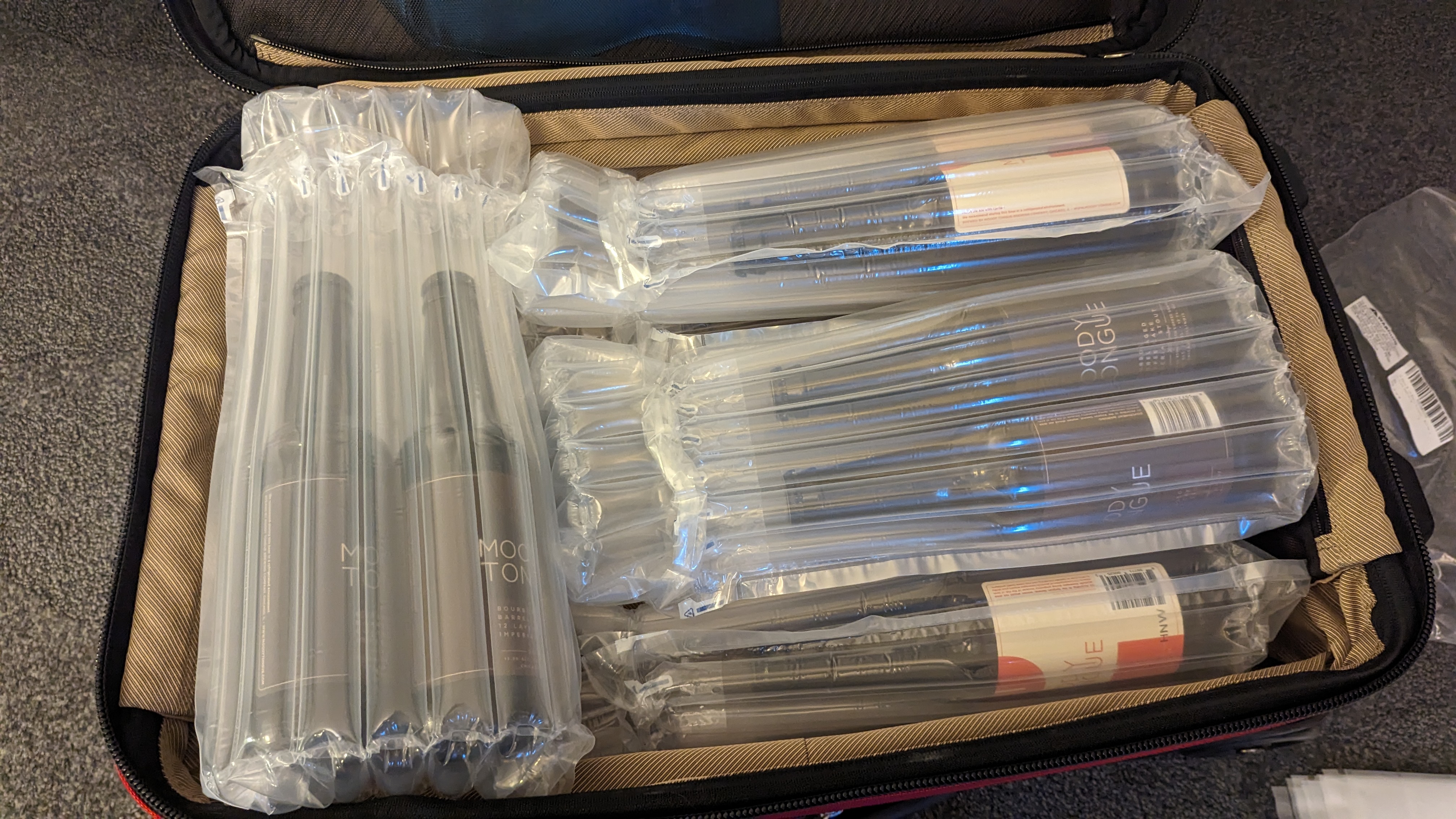
I checked into my hotel, popped some melatonin, and tried to get to sleep.
There’s a saying in running that the sleep the night before a race doesn’t matter, but the prior night’s sleep does. Well, I slept exceedingly poorly and I knew this could be bad, since I don’t ever sleep well the night before the race.
My training partner, Tanvir, and I went to the Tracksmith shakeout run, which felt pretty good, and then immediately headed to the expo to pick up our bibs. This was a key move. By the time we got there at 9:30am, it was already crowded with long lines; I definitely wouldn’t recommend getting there any later. (We later learned that the location of the expo, the McCormick Center, was the site of a migratory bird massacre that weekend).
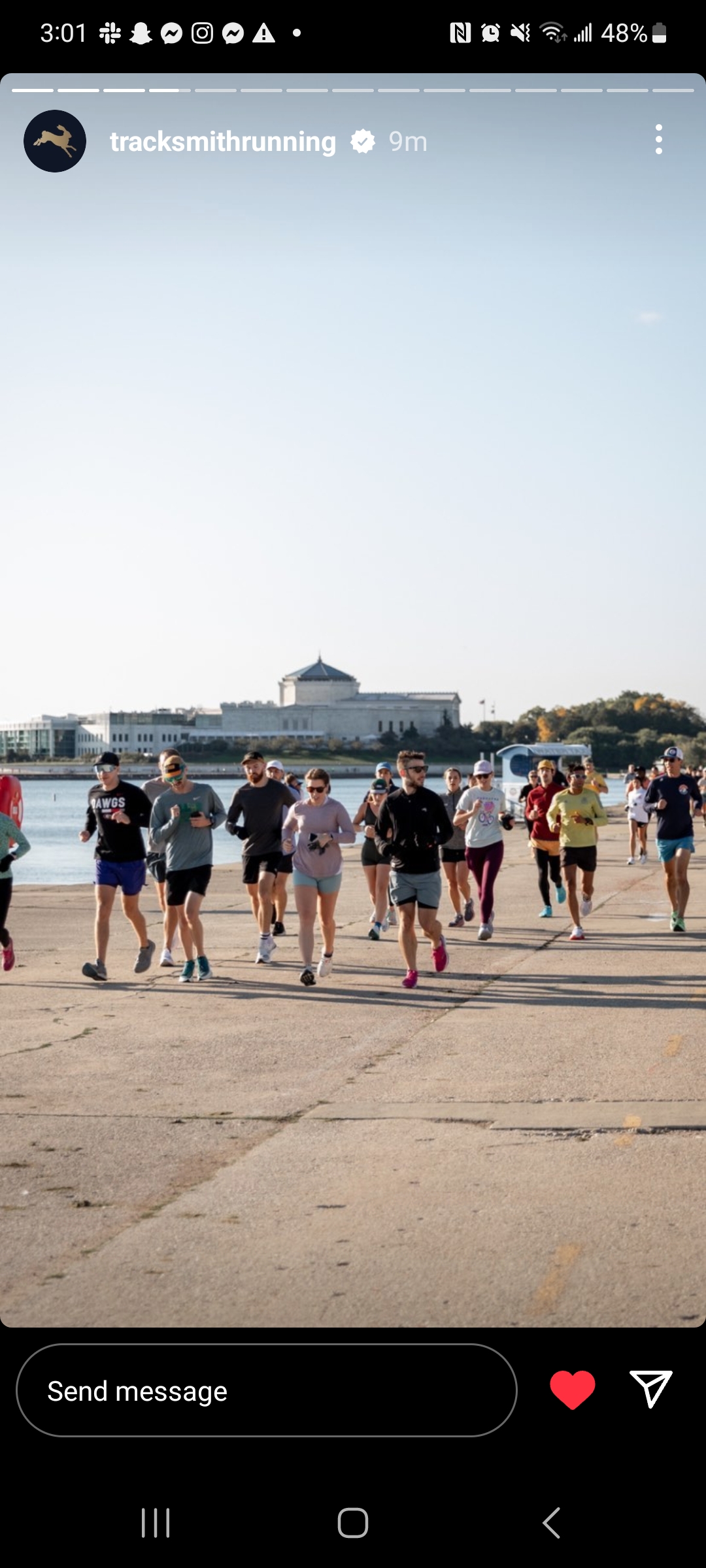
We were featured on Tracksmith’s Instagram profile (far right).
I got back to my hotel, futilely tried to take a nap, and went to a tourist trap for a pancake lunch. (I had wanted to enjoy the weather by eating in Grant Park, but I was swiftly attacked by yellow jackets, which apparently were also a factor for the post-race festivities). I relaxed in bed, got some pasta delivered, and layed out my clothes for the race.
Pre-Race
After another mostly sleepless night, I got out of bed, got kitted up, and went downstairs for an early breakfast that the front desk staff said would be awaiting marathon runners. I had envisioned a full continental breakfast spread like at the W in Boston last year. What it actually turned out to be was a brown bag that contained a bad bagel, a small tub of peanut butter, and a banana, and the offer of coffee for $12.
The race documentation says to get to one’s designated entry gate at exactly the time the gates open, 5:30am, which would mean two hours standing in the cold. I opted to arrive around 6:15am, which was plenty of time, especially since I wasn’t checking a bag. I sat around in my trash bag for a while, got in line for the portapotty but ultimately peed against a fence because the line was far too long. It was so crowded that I didn’t get a warm-up in; I decided to not run in circles in our corral, mostly because it seemed too much like a mosh pit.
Unlike New York, there is no cannon being repeatedly fired and keeping the awaiting runners on edge and periodically infusing adrenaline. But, for this ‘90s Chicago Bulls fan, “Sirius” by the Alan Parson’s Project hit the spot to hype me up for this Chicago race.
Race
The plan I came up with was to take advantage of the flat course and hold steady at 6:40/mi pace with little deviation.
The start was a bit congested, but I got up to between 6:20/mi and 6:30/mi pretty quickly and was able to hold it. It was a little dangerous because, somehow, there was occasionally a participant that I had to pass who was practically walking in the middle of the race course. I have no idea how they got so far ahead of me, only to come to a standstill and become a course hazard.
But I felt good. I decided just to roll with my 6:20-6:30/mi pace as long as I could. It was feeling almost effortless and there were no consequences of me flaming out before the finish line. With my unexpected freshness at the end of Boston in mind, I knew I wanted to finish here without much left in the tank, so I YOLO’ed it.
While there were no official pacers for finishing times below three hours, I actively tried to find groups going my desired pace. I found a bunch of packs that met the criteria, only for them to slow down. I ended up bridging from group to group, at my desired pace, with an unexpected benefit: it felt psychologically nice passing by so many people for so much of the race. I can’t think of a race I’ve ever run where this happened.
I passed running YouTuber Matt Choi and said hi. I passed Thomas Eller, the first born-deaf six star finisher ever and the focus of a recent short documentary, on his way to his fifth of six major marathon finishes this year.
But overall, I was very focused on trying to maintain pace, so much so that I noticed the crowds and the environment so much less compared to my prior marathons. I didn’t give any high fives, I did not yell to rile up the crowd, and I did not receive any power-ups. Someone later mentioned how excited they were to have passed the Bull’s stadium and how they enjoyed the different atmospheres of the neighborhoods… I really didn’t know what they were talking about. This was good and bad; though one day, I’d love to run a marathon and really soak in the event.
Mount Roosevelt, an overpass over the train tracks at about 800 meters from the finish, and practically the only elevation on the entire course, was surprisingly impactful. I dropped down to a low of 7:22/mi before the crest of the “hill” and then kicked hard around the turn toward the finish.
I crossed the line and I knew I bagged a massive PR without much left to give.
Post-race
I took my medal, my mylar thermal blanket and my Goose Island 312 Wheat Ale recovery beer and waddled toward the exit. I’m really happy that I didn’t check a bag; the line was already pretty long and I heard it got even worse. I saw a woman let out a series of blood curdling screams after having her legs completely cramp and seize up. There are a whole bunch of stairs between the finishing area and the park exits, which were unappreciated.
I met up with Tanvir over at the Tracksmith pop-up store where they were selling a “heirloom, custom-embroidered hoodie” which sounded nice, but not $280 nice. I took my free poster personalized with my finishing time back to my hotel and took a long hot shower.
Tanvir’s and my requirement for a post-race meal in Chicago was pretty obvious: deep-dish pizza. But we also didn’t want to get stuck in a tourist trap. Tanvir did some sleuthing and expertly made a reservation at Pequod’s, which I highly recommend. While I still favor New York-style pizza, Pequod’s really hit the post-marathon, calorie-deficient spot, with an cozy, authentic atmosphere that felt like a neighborhood pizza joint should. I’d go back for sure, even not after running 26.2 miles.
Then I applied my research and brought us to Pilot Project Brewing, which incubates small batch brewers in their space and sells the beers up front. I had one (okay, I had three of them) of the best beers I’ve ever had in my life: Lassi by Azadi Brewing, an alphonso mango milkshake IPA. It was creamy and sweet and sharp; it tasted almost exactly like someone poured a lassi into my beer.
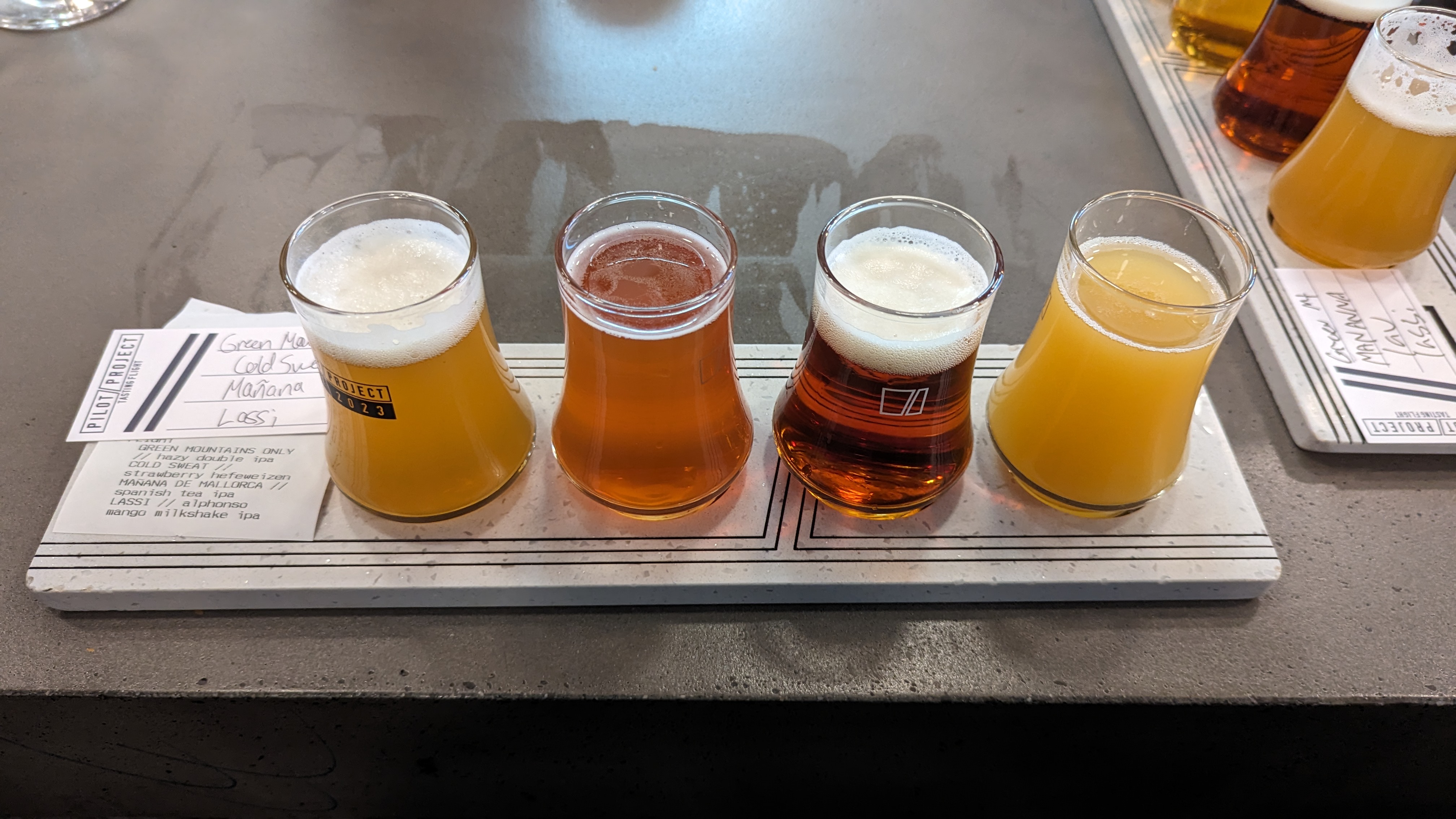
My friends parted ways one to catch a flight and another to (finally) take a shower, but I was still up for more beer and fun. I went down the street to Rev Brewing’s brewpub for a Ryeway to Heaven (a delicious 15% ABV barrel-aged ryewine) and then to Emporium Arcade Bar for a lovely God Damn Pigeon Porter from local Spiteful Brewing while playing some pinball.
I headed home the next day. I popped open a gift earmarked for celebrating after a successful run.
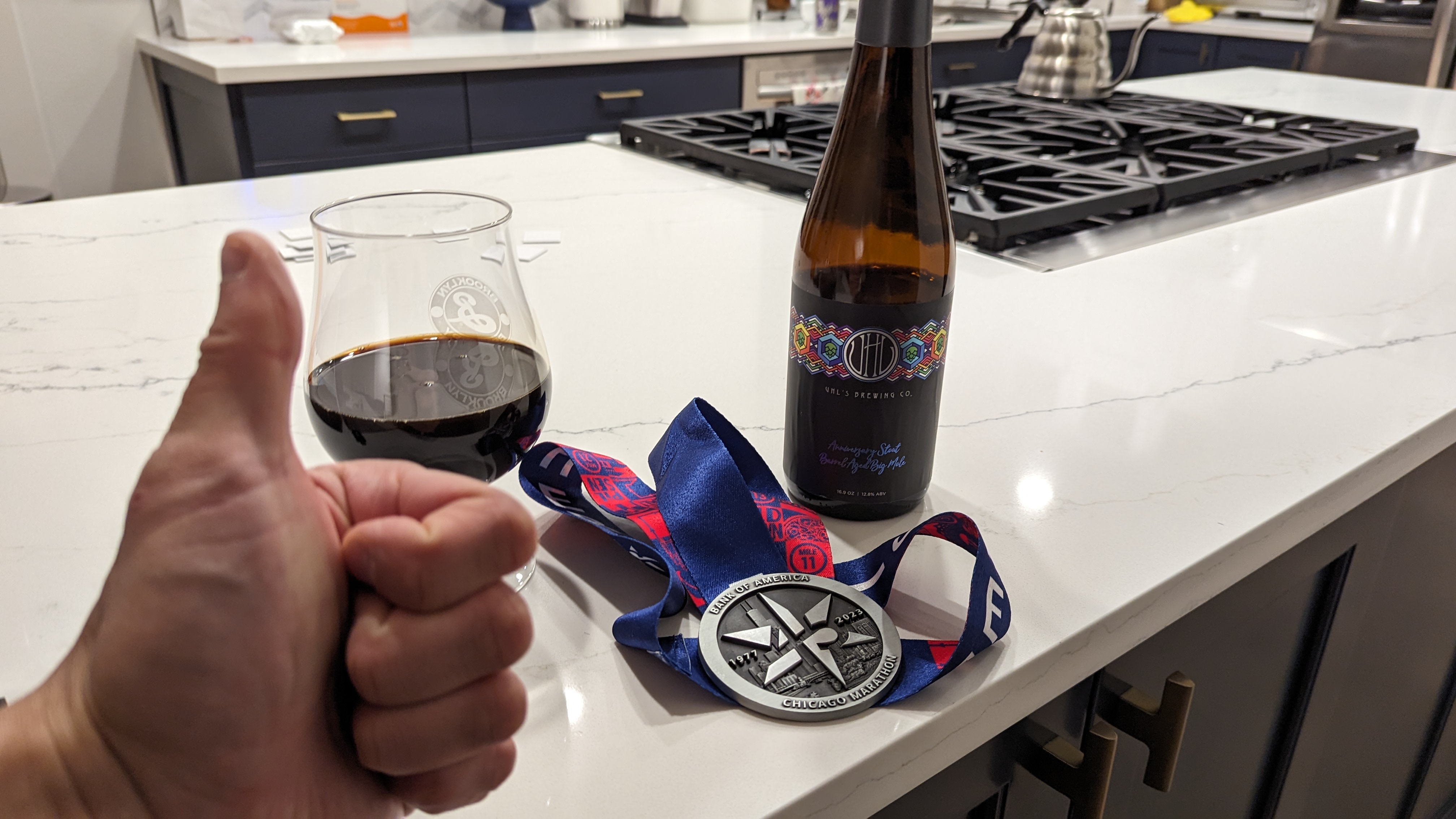
Next up: Boston (again)!